
Why overhead and bridge cranes remain the backbone of heavy lifting
In modern factories and warehouses, lifting is not just a task; it is a critical part of production flow, safety management, and space optimization. An industrial overhead travelling crane or bridge crane (often called an EOT crane) provides a reliable way to move heavy loads across large bays while keeping floors clear for people, vehicles, and equipment. Compared with mobile lifting options, an overhead system uses runway length and building height to deliver predictable travel, repeatable positioning, and high duty-cycle performance—exactly why many buyers search for an overhead crane for sale when they need consistent material handling.
The business case for an overhead crane manufacturer to solve is usually straightforward: a properly specified warehouse overhead crane or workshop overhead crane reduces handling time, lowers product damage, and improves ergonomics by minimizing manual intervention. Yet the real value comes from engineering discipline in the bridge crane system. When lifting becomes part of the production process—feeding CNC machines, moving molds, handling coils, or positioning assemblies—consistency and uptime matter as much as rated capacity. A well-built EOT crane is designed to deliver controlled motion under load day after day, with maintenance that can be planned rather than reactive. For a practical guide to modern facility requirements, see this guide to manufacturing and selling industrial overhead cranes.
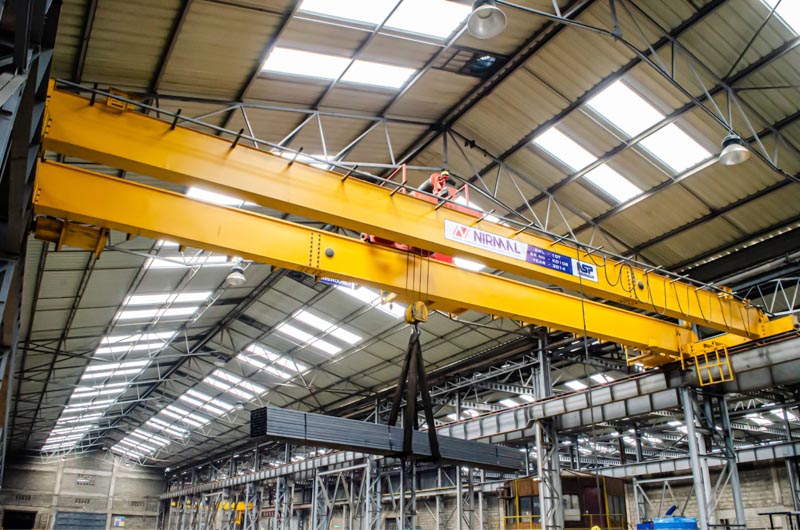
Core crane categories: single girder, double girder, and EOT systems
“EOT” (electric overhead traveling) describes the system concept: a bridge crane traveling on runways with an electric hoist or trolley. Within that concept, the single girder overhead crane and double girder overhead crane cover most industrial needs. A single girder overhead crane typically uses one main beam (girder) supporting a hoist trolley, making it common for moderate spans and duty cycles where a compact, cost-effective overhead travelling crane solution is preferred without sacrificing safety.
A double girder overhead crane uses two main beams and generally supports higher capacities, longer spans, and more intensive duty classifications, including applications that may require a 10 ton overhead crane up to a 100 ton overhead crane. Double girder designs also offer more flexibility in hoist positioning and can provide improved hook approach, depending on configuration. In many heavy industries—steel service centers, foundries, power equipment, paper mills, and large fabrication shops—double girder overhead crane designs are chosen to support high utilization and heavier duty cycles while maintaining stable travel and lifting characteristics.
Beyond girder count, an EOT crane performs according to details such as end truck design, wheel arrangement, rail interface, drive selection, braking, and controls—whether it is a top running overhead crane on runway rails or an underhung overhead crane suspended from the building structure. Two cranes that look similar on paper can behave very differently in operation depending on structural stiffness, alignment tolerances, and component quality. That is why a reputable overhead crane manufacturer treats the bridge crane as a complete system rather than a collection of parts.
From inquiry to specification: getting capacity, span, and duty right
Manufacturing and selling an overhead crane for sale begins with translating a customer’s lifting tasks into engineering requirements for the overhead travelling crane system. Rated capacity is only one element. The load spectrum, number of starts per hour, average travel distance, lifting height, and environmental conditions all influence duty classification and component sizing. A crane that repeatedly handles near-capacity loads—such as a 10 ton overhead crane in continuous production or a 100 ton overhead crane in heavy assembly—requires different motors, gearing, brakes, and structural margins than a crane used occasionally for maintenance lifts.
Span and runway length affect bridge crane girder design and deflection limits, which in turn influence load sway and positioning precision. Hook approach, headroom, and lifting height must be matched to the building envelope and the runway system for a top running overhead crane or the suspension geometry for an underhung overhead crane. Where loads are long, flexible, or prone to rotation, features like dual hoists, synchronized lifting, or anti-sway controls may be considered to improve safety and throughput in a workshop overhead crane application.
A robust specification process for an EOT crane also anticipates future needs. Expansions, new product lines, or changes in production layout can quickly make a minimally sized bridge crane feel restrictive. Investing in the right classification and runway capacity can protect the facility’s lifting capability for years, especially when the overhead travelling crane becomes a central tool for material flow rather than a backup device.
Manufacturing process: engineering, fabrication, and quality control
Industrial overhead crane manufacturer work blends structural fabrication with mechanical and electrical integration. Engineering typically begins with structural calculations for single girder overhead crane or double girder overhead crane girders, end trucks, and connections, followed by selection of hoists, drives, and control architecture. Deflection criteria, fatigue considerations, and dynamic effects from acceleration and braking must be addressed, particularly for high-duty EOT crane applications and long spans. The goal is not only strength but also stiffness and predictable behavior under real operating conditions.
Fabrication quality is central to bridge crane longevity. Precision cutting, welding procedures, and dimensional control affect wheel alignment and rail interaction, which are common sources of wear if not managed correctly on a top running overhead crane runway. Surface preparation and coating systems are chosen based on environment; a warehouse overhead crane may prioritize clean finishes and corrosion resistance, while harsher settings may demand more robust paint systems or specialized protection. The manufacturing line should incorporate inspection checkpoints for weld integrity, geometry, and fit-up before mechanical installation of the overhead travelling crane.
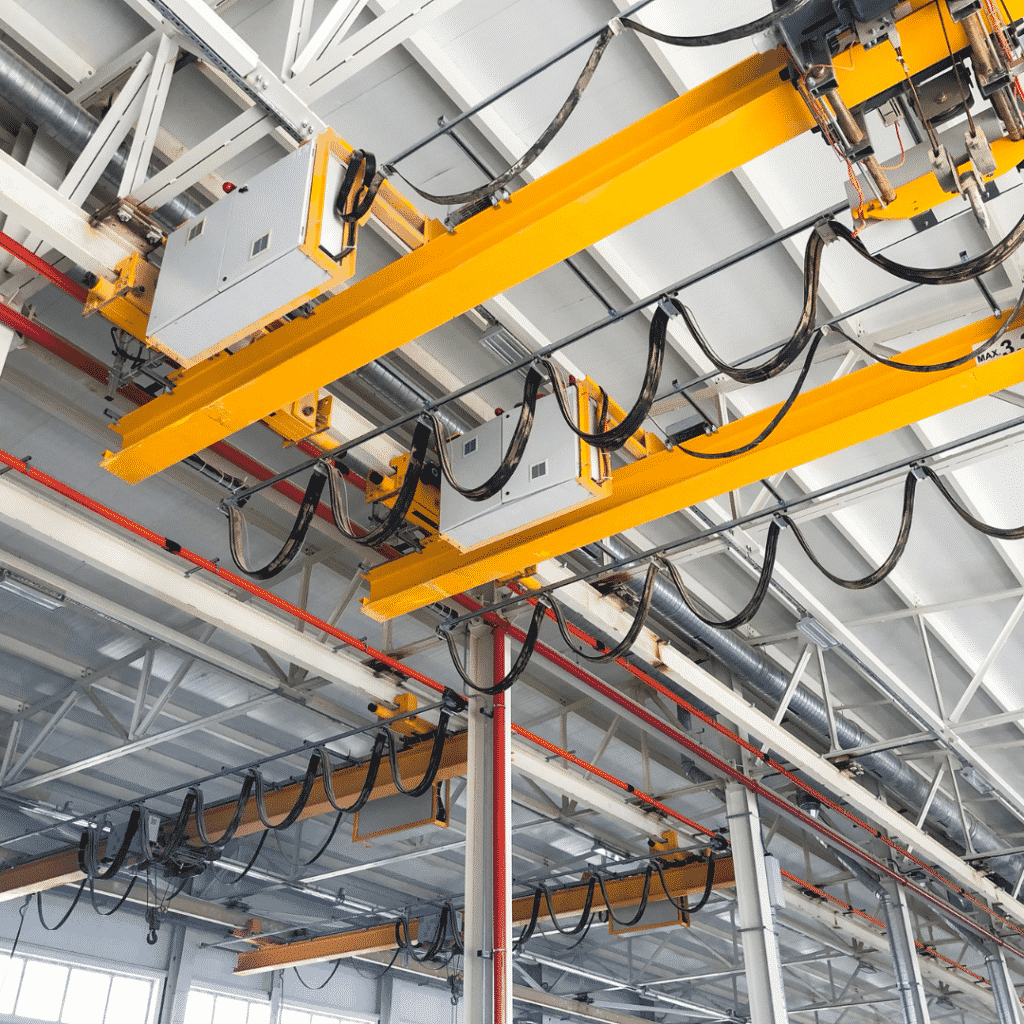
Integration includes hoist mounting, trolley assembly, cabling, festoon or conductor systems, limit switches, overload protection, and braking systems for the complete EOT crane. Final testing typically verifies travel speeds, lifting performance, braking distance, limit functions, and control response. When an overhead crane manufacturer emphasizes traceable quality and documented testing, the result is a bridge crane that performs predictably and supports compliance requirements in regulated environments.
Steel structure solutions: runway beams, columns, and crane-supporting frameworks
A bridge crane is only as good as the structure that supports it. Many projects require more than supplying the overhead crane for sale; they require a complete steel structure workshop or steel structure warehouse solution. This can include runway beams, brackets, columns, tie beams, and bracing designed to carry vertical wheel loads, lateral forces, and longitudinal loads from acceleration and skewing of a top running overhead crane. For existing buildings, structural evaluation is often necessary to confirm that columns, foundations, and connections can accept EOT crane loads without excessive deflection or fatigue risk.
In greenfield facilities, integrating overhead travelling crane loads early in the building design can reduce total cost and improve performance. Runway alignment tolerances, rail selection, and expansion joints must be coordinated with the steel structure warehouse or steel structure workshop design. In retrofit installations, the steel solution may need to avoid production interruptions, fit around existing equipment, and accommodate limited access for erection. A comprehensive approach focuses on system compatibility between crane and structure, ensuring the bridge crane and its supporting steelwork function as one system.
Installation and commissioning: turning design into safe operation
Even the best overhead travelling crane can underperform if installation is rushed or misaligned. Erection includes positioning runway rails for a top running overhead crane (or verifying suspension members for an underhung overhead crane), checking straightness and elevation, installing end stops, and ensuring that electrical supply and conductor systems are properly protected. Bridge crane alignment, wheel contact patterns, and travel smoothness are checked before load testing. Commissioning also includes setting limit switches, verifying overload devices, and confirming emergency stop behavior for the EOT crane.
Operator training is an often underestimated part of commissioning for a warehouse overhead crane or workshop overhead crane. Clear guidance on load handling, travel practices, inspection routines, and reporting of unusual sounds or behavior can prevent early wear on the bridge crane, hoist, and runway. In facilities with multiple shifts, consistent operating practices reduce the chance of shock loading and improve component life. A professional handover includes documentation, maintenance schedules, and recommended spare parts aligned with the plant’s uptime strategy for the EOT crane.
Controls, safety, and productivity features that add real value
Buyers evaluating an overhead crane for sale increasingly look for features that improve both safety and throughput. Modern EOT crane control options include pendant controls, radio remotes, and cabins for specific applications. Variable frequency drives can provide smoother acceleration and deceleration, reducing load swing and mechanical stress on the bridge crane structure and runway. Load monitoring, fault diagnostics, and event logging support maintenance planning and help identify patterns such as repeated overload attempts or excessive starts.
Safety is not a single component; it is a design philosophy built into every overhead travelling crane. Overload protection, reliable braking, end stops, limit switches, and proper guarding are foundational for both single girder overhead crane and double girder overhead crane systems. For demanding environments, additional measures may include anti-collision systems, zoning, and controlled access procedures. For specialized risks and handling methods, options such as an explosion proof overhead crane, grab overhead crane, or magnetic overhead crane can be engineered so the crane becomes a predictable tool for safe production rather than a variable risk factor.
How crane suppliers approach sales: engineering support and lifecycle thinking
Selling industrial cranes is fundamentally consultative, especially for an overhead crane manufacturer offering complete bridge crane and steel structure packages. The most effective suppliers focus on understanding the lifting process, the building constraints, and the customer’s operational priorities. A proposal should clearly define capacity, span, lifting height, duty classification, speeds, control type, and the scope of runway beams and supporting steelwork for the EOT crane. It should also clarify assumptions, such as runway condition, power availability, and environmental factors like temperature, dust, or corrosive exposure that affect overhead travelling crane selection.
Lifecycle costs matter as much as purchase price for any overhead crane for sale. Component selection affects maintenance intervals, spare parts availability, and the ease of inspection on the bridge crane and hoist. Access platforms, service walkways, and smart routing of cables can reduce downtime and improve safety during maintenance, especially on higher-capacity double girder overhead crane systems. A supplier that plans for serviceability helps customers protect uptime, particularly when the warehouse overhead crane becomes essential to daily production.
Maintenance, inspections, and long-term reliability
Overhead travelling cranes operate in a demanding mechanical environment: repeated starts, braking events, and load cycles create fatigue over time in the bridge crane structure, end trucks, and hoist. Preventive maintenance typically includes checking wire ropes or chains, hook condition, brake wear, gearbox lubrication, wheel and rail wear, and electrical connections. Periodic inspections also verify limit switch function and structural integrity, including weld areas and bolted joints on single girder overhead crane and double girder overhead crane systems.
Reliability improves when maintenance is aligned with actual usage rather than fixed calendar intervals alone, particularly for high-duty EOT crane applications. A 100 ton overhead crane in heavy assembly may require more frequent checks than a lighter warehouse overhead crane, while condition-based monitoring can optimize both. Keeping records of inspections, repairs, and component replacements helps identify trends and supports decisions about modernization, such as upgrading controls or replacing a hoist while retaining the bridge crane structure and runway system.
Choosing the right partner for cranes and steel structures
The most successful crane projects combine sound engineering, disciplined manufacturing, and a clear plan for installation and support from an experienced overhead crane manufacturer. Whether the need is a single girder overhead crane for a warehouse bay, an underhung overhead crane for a constrained building, or a double girder overhead crane EOT crane system for heavy production, performance depends on the match between the bridge crane, the duty cycle, and the supporting steel structure workshop or steel structure warehouse. When specifications are accurate and execution is controlled, the result is a lifting system that improves safety, reduces handling time, and supports growth.
In a competitive industrial environment, overhead travelling crane equipment should not be an afterthought. A well-specified bridge crane is infrastructure that shapes workflow and productivity in factories and warehouses. Investing in the right EOT crane solution—supported by properly designed runway beams and steel structures—creates a practical advantage that can be measured in uptime, throughput, and confidence on the shop floor.